
Lenexa Tree Removal handles land clearing and lot clearing across Lenexa, KS, serving surrounding cities including Shawnee, Olathe, Merriam, De Soto, Edwardsville. Twenty years of clearing on both sides of the state line is what tells us which of the rules on a given parcel are real, because the answer changes at almost every city limit in this county.
Clearing is the one tree job where the paperwork can cost more than the machines. Lenexa’s tree and landscape provisions are development standards rather than a removal permit, and they ask for a survey, a common-name schedule, tree credits and protective fencing - all of which are cheap to satisfy before the work and expensive to satisfy after it.
The second cost nobody budgets is disposal. Between a three-inch diameter cap at the county landfill, a compost site limited to another city’s residents, a burn prohibition that closes April in this county, and a large private gate that refuses stumps with dirt, where the material goes is a decision that belongs in the estimate.
What a Clearing Job Has to Answer First
The Tree Survey and the Caliper Thresholds
Lenexa’s code asks that trees estimated at greater than ten inch caliper and proposed for removal be identified on plats and plans by common name, and that a tree survey submitted at final plan application locate and identify by caliper size each tree greater than ten inches, with save-and-remove marked. On a finished occupied lot none of this applies. On a development site it is the first thing a reviewer looks for.
Land Disturbance and Erosion Control
A clearing job that disturbs ground is a land-disturbance question as well as a tree question, and Lenexa’s own licensing material names fence, land disturbance and site development permits as a distinct category. Silt fence, inlet protection and a stabilized entrance are not decoration on a cleared lot; they are what keeps the site working after the first storm.
Locates, Before Anything Cuts Ground
Kansas 811 goes in before any stump grinding, excavation or root work, at 811 or 1-800-DIG-SAFE. On an infill lot the buried surprises are old service laterals, abandoned septic and irrigation; on a commercial pad they are site lighting and irrigation mains that were never as-built accurately.
Clearing to a Plan, Not to the Fence Line
Which Trees Are Worth Keeping
The code gives credit for keeping trees at one for one between two and ten inch caliper and two for one above ten, and the award criteria include the tree’s health, its function in erosion control, shade, wind protection and buffering, and its ability to withstand the impacts of construction.
That last criterion is the one that decides most arguments on site. A large tree with a decayed union, a compromised root plate, or half its critical root zone under the proposed drive is not a tree you keep; it is a tree you pay to remove twice.
Protection Fencing at the Drip Line
Where trees are being saved, the code requires a minimum protection zone with temporary fencing placed no closer to the trees than their drip lines, maintained throughout the construction period. We set that fence before the first machine arrives and plan the haul route and staging outside it, because compaction inside the root zone is the injury that kills a saved tree years later with nothing visible to blame.
Street Trees, the Fund and the Frontage Formula
On single-family and duplex subdivisions with average lot sizes under one acre, the City plants the street trees itself and the developer pays into the Lenexa Street Tree Fund instead. The formula is total linear feet of public or private street frontage divided by fifty, multiplied by a dollar amount adopted by the City Council, and payments are nonrefundable even if fewer trees are planted than the formula identified.
The fund is also mapped: three Street Tree Fund Zones split the city at Renner, K-10 and K-7, and surplus is spent within the zone it was collected in. None of that changes what we cut, but it changes what the frontage decision costs, so it belongs in the conversation before the plat is final.
Where the Material Goes
Chipping and Hauling
Most of what comes off a clearing job is brush, and most of it leaves as chips. Chips can be spread on site where a buyer wants them, delivered, or hauled out - and the volume is always larger than the standing material looked, which is the single most common reason a disposal line is underestimated.
Logs, Stumps and the Gate Rules
Logs go by the load to a gate that will take them. Missouri Organic Recycling accepts brush at ten dollars per cubic yard and lawn debris at seven, takes logs up to forty inches in diameter if they are under five feet in length, and refuses stumps with dirt - which is the reason grinding rather than pulling is usually the economical call here. The Johnson County landfill caps landscape waste at three inches in diameter.
Burning, and the Month That Is Closed
Kansas air regulation K.A.R. 28-19-645a prohibits open burning of waste, including vegetation and wood waste, during April in Johnson and Wyandotte counties, and does not name Leavenworth. Burning brush from nonagricultural land clearing needs approval from the local authority year-round regardless of month. Spring is when clearing gets scheduled, so we plan the material out by truck rather than around a fire.
The Jobs We Clear
A Build, an Addition or a Pool
Residential clearing is usually a pad, a drive line and a staging area, cut on a lot where the neighbors are close and the access is one gate wide. The constraint is rarely the trees; it is getting a chipper, a grapple truck and a stump grinder in and out without damaging the street, the walk or the lot next door.
Fence Lines and Overgrown Boundaries
An overgrown fence line is a clearing job with a fence inside it, and the fence is what makes it slow. Volunteer growth, hedge, and root balls come out in a way that leaves the line workable for whoever rebuilds it, rather than cutting to grade and leaving a row of stumps hard against the posts.
Commercial Pads, Basins and Frontage
Lenexa carries one of the metro’s larger business-park and warehouse concentrations, and the clearing work there is frontage, detention basins, drainage easements and overgrown outlots. Those jobs need erosion control that survives the job, buffers and floodplain lines checked against the map that governs the parcel, and scheduling that does not close a truck court in working hours.
Our Step-by-Step Land Clearing Process
1. Walk the Parcel Against the Plan
We walk the site with the plan, mark save-and-remove, measure the calipers that matter to the survey, and identify the access and staging. Anything that will need a survey line, a permit or a buffer check is flagged here rather than mid-job.
2. Set Protection and Erosion Control First
Protection fencing goes up at the drip lines of every saved tree and the erosion control goes in before clearing starts. Both are cheaper to install on an open site than to retrofit around a machine track.
3. Clear in Sequence, Away From What Stays
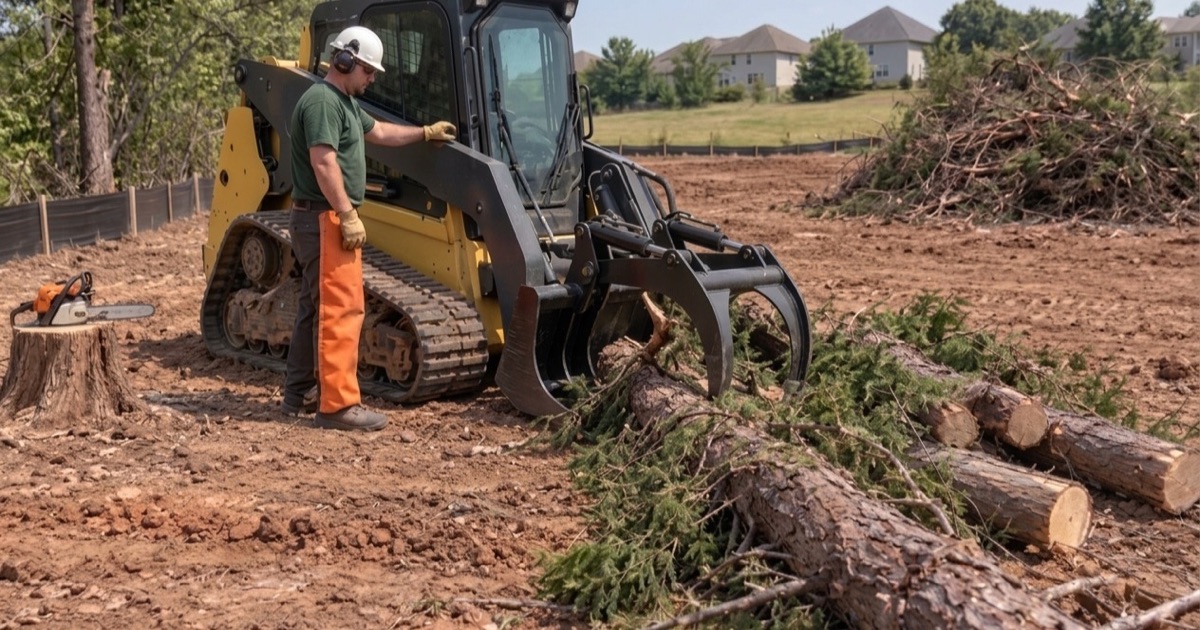
Work runs from the interior outward or from the access inward depending on the drop zones, using crane, grapple saw or spider lift where the felling room is not there. Machine routes stay outside protected root zones for the whole job, not just the first day.
4. Grind, Haul and Hand Over Clean
Stumps are ground or removed as the plan requires, the material goes to the gate chosen at estimate stage, and the site is left clear and rakeable for the grading or excavation contractor - with the disposal tickets available if the file needs them.
- Insured, Proof Provided
- 20+ Years in Johnson County
- Free Written Estimates