Lenexa Tree Removal provides tree disease treatment and plant health care in Lenexa, KS, and the first thing that work does is establish whether the tree is actually diseased. Twenty years of removals here has produced a fairly blunt view: a large share of the trees called in as sick are stressed instead, and stress and disease need opposite responses.
That distinction is worth money. A tree declining because its root flare is buried under six inches of fill will not improve after any treatment, and a tree with pine wilt cannot be treated at all - it has a removal deadline published by the state extension service. Selling a treatment in either case is selling a season.
So the order here is diagnosis, then the decision, then the treatment if there is one. Where a removal is the honest answer we say so and price it against whatever alternative is realistic, rather than starting from what is easiest to sell.
Diagnose Before Treating
What the Symptoms Already Rule Out
The pattern tells you most of it. Damage confined to one side of a tree - the side facing the prevailing wind - reads as winter injury rather than infection. Dieback that starts low and works upward is a different story from dieback that starts at the top. Where in the crown it began, and how fast, narrows the list before anybody touches the tree.
Instruments, Where They Change the Decision
Sonic tomography times sound across a stem to map internal decay and leaves nothing behind; a resistograph reads drilling resistance through a fine probe to measure the wall of sound wood remaining. Both are used where the answer decides whether a tree stays, not to decorate a report. Evergy’s own published hazard list is a good short version of what we are looking for: dead or dying wood, severe lean, weak branches, root failure, cankers, conks and internal decay.
The Answer That Is Usually Underground
A trunk that enters the ground like a post, with no visible flare, is buried, and an air spade strips that soil away without cutting roots so the collar can be inspected for girdling roots and decay. On this city’s newer stock - about 21 percent of the housing was built in 2010 or later, on engineered fill and compacted subgrade - the diagnosis is very often the ground rather than a pathogen.
Pine Wilt and the Failing Conifers
What K-State’s Publication Describes
Publication L722 is the local reference, and its vocabulary is directly usable. Pine wilt shows reduced or absent resin, and the brown needles stay on the tree for up to a year after it has died. Dothistroma browns the needle tip while the base stays green, giving a tufted appearance with the tree bare in the interior of the lower part; pycnidia look as though black pepper has been shaken onto the cones.
The One Removal With a Published Deadline
Pine wilt is the only job in this trade where a state extension service mandates stump removal as sanitation rather than for yard usability. L722 directs that the tree be cut down as soon as possible, or by May 1 at the latest with April 1 a better deadline, cut to the ground with no stump left, and the wood chipped or burned immediately rather than saved for firewood.
The Species Contradiction Worth Knowing About
K-State’s own publications do not fully agree here, and it is more useful to say so than to smooth it over. A K-State horticulture page on blue spruce recommends Austrian and ponderosa pines as better choices, while L722 makes Austrian pine a host of all three of its named diseases, and the Johnson County extension brochure lists Austrian pine as not recommended at all. L722 also records that Scots pine plantings in eastern Kansas have been devastated.
Ash, Oak and the Decisions That Cost Money
Emerald Ash Borer: Treat or Remove
This is a budget decision made once and then lived with. Treating a healthy, well-sited ash on a cycle keeps a mature shade tree; not treating it means paying for a removal later, on brittle wood, usually with a crane. The county extension brochure already lists green ash among the trees it does not recommend planting here, which is the clearest signal about what the future of that species looks like locally.
Oak Wilt and the Grafts Underground
Oaks in a group are frequently connected root to root, and oak wilt uses those grafts as well as beetles attracted to fresh wounds. That means two things in practice: root graft trenching before an infected oak is removed, so the neighboring tree is not infected through the ground, and keeping oak pruning out of the high-risk spring window unless a real hazard forces it.
Firewood, and How These Problems Travel
Moving cut wood is one of the ways tree pests cover ground they could never cross on their own, and the Missouri Department of Conservation’s published guidance is not to move firewood more than fifty miles. On a pine wilt removal the rule is stricter still and comes from the extension publication itself: chip or burn immediately, and do not keep the wood.
Plant Health Care for a Tree That Is Stressed
Root Collar Excavation and Girdling Roots
Exposing the flare with an air spade is diagnosis and treatment at once. Girdling roots wrapped around the stem can be cut out while they are still small enough that removing them does not destabilize the tree, and the flare can be left at grade rather than under fill - which is the condition it needs to stay healthy in.
Decompaction and Radial Trenching
Roots need air and water, and compacted subgrade supplies neither. Radial trenching cuts narrow spokes outward inside the critical root zone and backfills them with a medium roots can actually move through, which turns a sealed profile into one a tree can work with. It is treatment for a tree that is stressed rather than sick, and it takes seasons rather than weeks to show.
Mulch, Water and the Things Not to Do
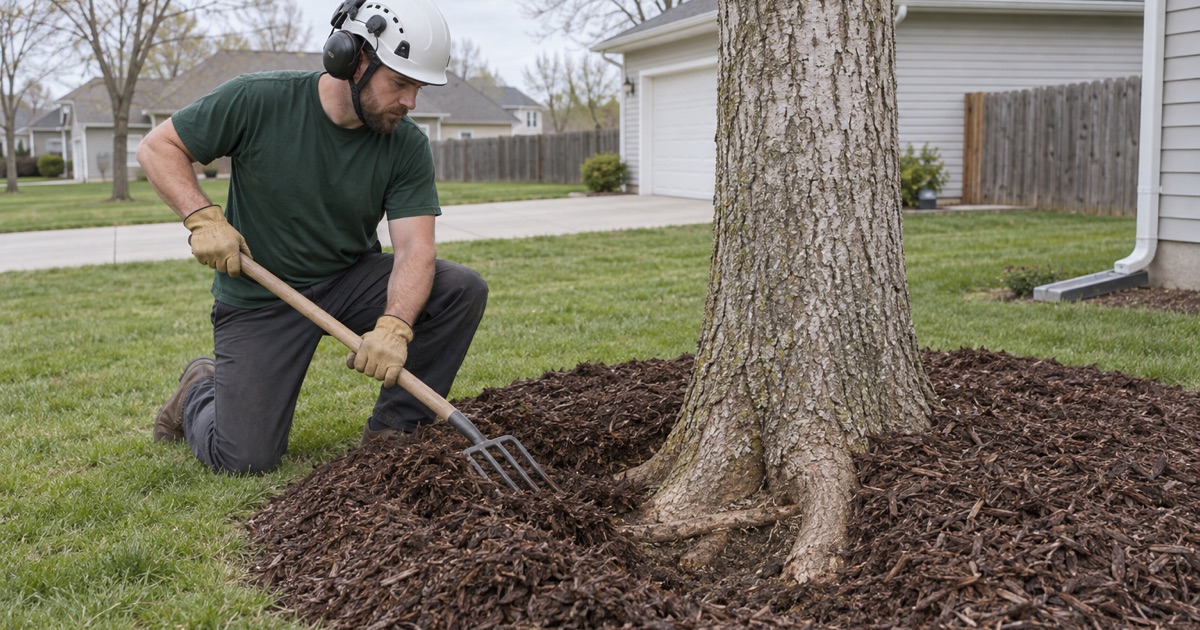
Most of what helps a struggling tree costs very little: mulch out toward the drip line and pulled back off the trunk, deep and infrequent water rather than daily sprinkler minutes, and no fertilizer pushing top growth a damaged root system cannot supply. We would rather tell you that than sell an annual program the tree does not need.
- Insured, Proof Provided
- 20+ Years in Johnson County
- Free Written Estimates