
Lenexa Tree Removal provides stump grinding across Lenexa, KS, serving surrounding cities including Shawnee, Olathe, Merriam, De Soto, Edwardsville. Twenty years of grinding on this ground is why the depth question gets an honest answer here rather than a number that sounds good on the phone.
Stump grinding is the part of a removal where the estimate and the result most often disagree, because what a wheel can reach depends on the soil, the fill and what somebody buried on that lot in 1978. We quote the depth for the stump in front of us, and we say plainly what will still be under the grass afterward.
It is also the step that decides your disposal cost. Missouri Organic Recycling, the nearest large gate, refuses stumps with dirt, and the Johnson County landfill caps landscape waste at three inches in diameter, so a pulled stump has fewer places to go than most people expect. Grinding sidesteps that problem instead of creating it.
What Grinding Actually Removes
Depth, and the Root Plate That Stays
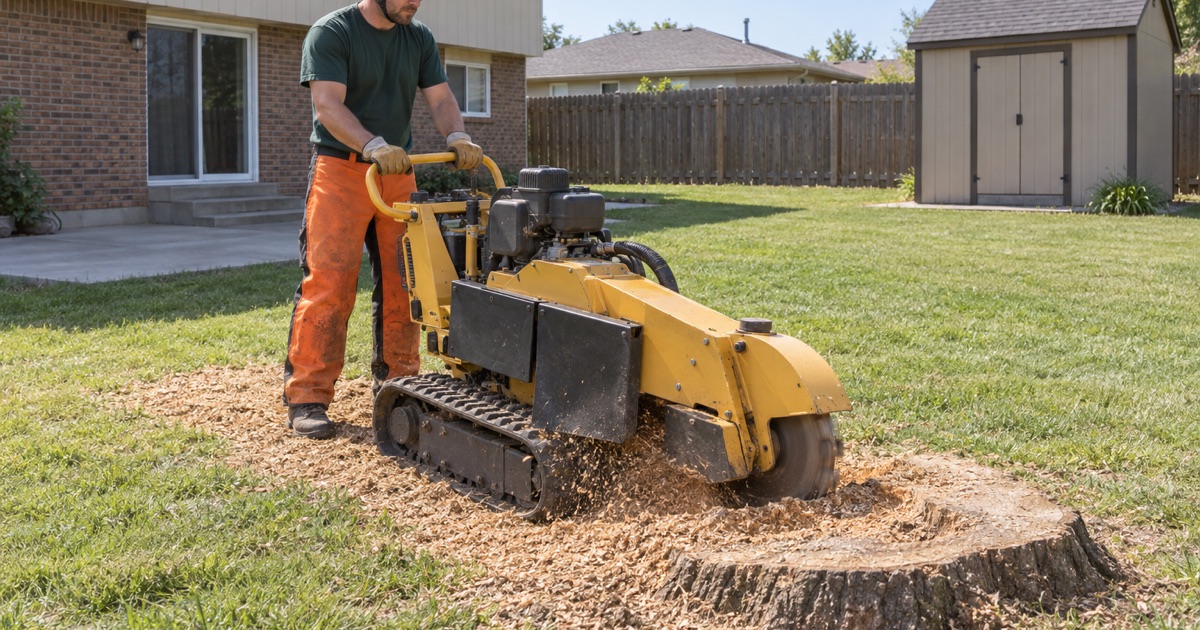
A stump grinder cutting wheel works roughly twelve to twenty-five inches below grade, taking the stump, the flare and the major surface roots where the machine can reach them. What stays is the fine root system, decaying over several years. That is enough ground for turf, a patio base or a bed; it is not clean soil, and anybody who tells you the roots are gone has not run the machine.
The Grindings, and Where They End Up
Grinding produces a volume of chips noticeably larger than the stump looked, because the material is aerated on the way out. Left in the hole it settles several inches over the first season and wants topping up; taken away it leaves a soil-backfilled hole ready to seed.
The grindings are also almost pure carbon, so they tie up nitrogen while they break down. That makes them poor planting medium and reasonable mulch for an established bed, which is a distinction worth making before somebody spreads them around a new shrub.
Regrowth, and the Species That Argue
Grinding kills most stumps outright, but several species will push suckers from roots that the wheel never reached. Where that is likely we flag it at the estimate rather than after, and the honest answer is usually a season of cutting suckers as they appear rather than a treatment nobody agreed to.
Ground Conditions That Decide the Depth
Deep Loess, Where the Machine Is the Limit
Much of this ground is loess-derived and genuinely deep - the Knox series runs more than 180 centimeters to carbonates and Sharpsburg more than 150 - so against a wheel rated at twelve to twenty-five inches the machine binds long before anything geological does. On those lots the depth conversation is about access and clearance rather than about rock.
The Shallow Series That Change the Answer
Eastern Kansas also carries residual series formed over the interbedded limestone and shale of this cuesta landscape, and they are shallow. Vinland is described with solum thickness and depth to bedrock of twenty-five to fifty-one centimeters - about ten to twenty inches - and USDA describes its distribution in eastern Kansas as extensive. On Vinland the rock stops the grinder; on Oska, at fifty-one to a hundred and two centimeters, it brackets it.
Engineered Fill on the Newer Half of the City
About 21 percent of Lenexa’s housing was built in 2010 or later, and on those lots the working medium is imported fill and compacted subgrade rather than the mapped soil at all. A soil survey does not describe engineered ground, and neither does a phone quote.
What that means in practice is that we look at the stump before committing to a depth, and where the grade has obviously been built up we say so and price the risk rather than absorbing it into a number we then have to renegotiate.
Utilities, Roots and What Stops a Grinder
Kansas 811 Before Anything Turns
Every grinding job starts with a locate. Kansas 811 is the state one-call notification center, reachable at 811 or 1-800-DIG-SAFE, and a stump sitting three feet off a meter or over an irrigation main is exactly the situation the system exists for. Private lines past the meter are not covered, so low-voltage lighting, invisible fence and pool feeds get asked about separately.
The Neighboring Tree’s Critical Root Zone
A stump rarely stands alone. Where the grinder would work inside the critical root zone of a tree that is staying, the cut is planned to avoid severing structural roots on that tree’s side, because a grinding job that quietly destabilizes the oak next to it has traded one removal for two.
Hardscape, Fences and the Approach
The machine has to get there. Gate width, a retaining wall, a septic field or a paver patio decides whether a full-size grinder or a narrow-access machine comes out, and that decision changes both the price and the reachable depth. We work that out at the estimate rather than sending a truck that cannot fit down the side of the house.
Residential and Commercial Stump Grinding
Residential Lots After a Removal
On a house lot the stump is usually the last step of a job and the one the client sees for years afterward. We backfill, we clean the spill off the drive and the walk, and we leave the area rakeable and ready to seed, rather than leaving a mound of chips for somebody else to deal with in the spring.
Multifamily, HOA and Property-Managed Grounds
Nearly forty-four percent of Lenexa’s housing is attached or multifamily, so a great deal of the grinding here is ordered by a board or a management company against a common-area budget. Those jobs get a written scope per stump and a schedule, because the work has to be defensible in a file rather than agreed at a curb.
Business Parks, Truck Courts and Parking Islands
Commercial sites bring a different constraint, which is uptime. Grinding in a parking island or beside a dock apron is scheduled around operating hours, the surrounding surface is protected, and the area is swept and reopened the same day rather than left coned off through a working week.
Our Step-by-Step Stump Grinding Process
1. Look at the Stump, Not the Photograph
We measure the stump and the flare, check the grade for the tell-tale signs of imported fill, look at what sits within throwing distance of the wheel, and settle the access route the machine will actually take. That visit is what makes a quoted depth mean anything, and it is why we do not price grinding from a photograph sent over the phone.
2. Locate Before Cutting
Kansas 811 goes in and the response is on the ground before the machine is. Private utilities past the meter get asked about separately - low-voltage lighting, invisible fence, pool feeds and irrigation mains are all invisible to the public locate - and the heads and runs near the stump are marked by hand. Nothing turns until every mark is down.
3. Grind, With the Surroundings Protected
Boards and mats go up wherever chips would otherwise reach a wall, a window, a parked vehicle, a pool or a neighbor’s siding, because a grinder throws further than most people expect. The wheel works the stump down and then outward along the roots the access allows, and the depth is checked as the job goes rather than asserted once the machine is back on the trailer.
4. Backfill or Haul, as Written
Whichever the estimate says: the grindings pulled out and the hole backfilled with soil ready to seed, or the chips leveled in place with the settlement over the first season explained so nobody is surprised by the dip in June. Either way the drive, the walk and the surrounding turf get blown and raked down before we leave.
5. Say What Is Still Under There
We finish by telling you exactly what remains - the depth actually reached, the root plate left behind to decay, and whether that spot will carry a fence post, a replacement tree or only turf. It takes a minute to say and it is the sentence that prevents an argument two summers later when somebody hits a root with a post-hole auger.
- Insured, Proof Provided
- 20+ Years in Johnson County
- Free Written Estimates