Lenexa Tree Removal handles property line and neighbor tree removal in Lenexa, KS, which in this metro is a legal question before it is a cutting question. Twenty years of working both sides of the state line has made that unavoidable: the rule governing a tree overhanging a fence changes depending on which state the fence is in.
That is not a technicality. In Kansas a documented hazard gives you leverage over a neighbor who will not act. In Missouri the identical report is documentation for work you pay for yourself. Same species, same defect, same distance from the house - two different outcomes, and the difference is a line on a map.
So this work starts with establishing whose tree it is, which rule applies, and what may be cut from where. Only then does anyone quote the removal, because a crew that starts before those three answers exist is a crew creating a dispute rather than solving one.
The Two Rules, and Which One Governs Your Fence
Kansas: the Nuisance Rule
Kansas follows what the courts call the Hawaii or nuisance rule, established in Pierce v. Casady as a case of first impression. A landowner may trim what overhangs their own land but may not enter the neighbor’s property to do it, and where a tree does substantial harm or creates an imminent danger it may be a nuisance the neighbor can be compelled to abate, with damages available for injury the tree causes.
Missouri: the Massachusetts Rule
Missouri went the other way in Hasapopoulos v. Murphy, agreeing with the jurisdictions that find no cause of action for damage from the roots or branches of a healthy tree. Self-help is the remedy and it is at your own expense. Liability attaches only where the owner has maintained a tree in a damaged, decayed or diseased condition - which is precisely why the condition of the tree is the thing worth documenting there.
What Changes When You Cross the Line
The practical translation is short. On the Kansas side, an arborist report is leverage: it is the evidence behind a demand that a neighbor deal with their tree. On the Missouri side, the same report is a record supporting either a claim about a demonstrably defective tree or, more often, a decision to pay for your own trimming and be done with it.
What You May Cut, and Where You Must Stop
Overhanging Branches
The right to cut what overhangs your line is real and it is limited. It is a right to remove the encroachment, not a right to reshape the neighbor’s tree, and pruning that damages or destabilizes the tree can create its own liability. We cut to the line properly, at the right point on the branch, rather than making a vertical wall of stubs a foot inside somebody’s canopy.
Entering the Neighbor’s Land
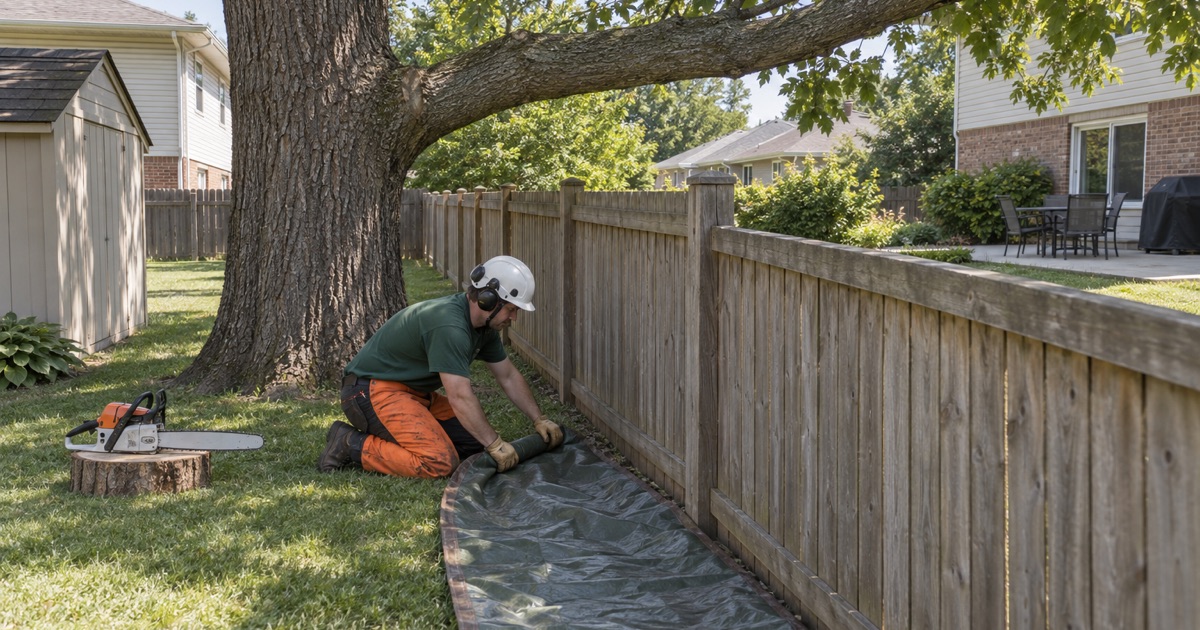
The Kansas rule is explicit that the right to trim does not include a right of entry. On a narrow lot that single sentence decides the whole method: a lift on your own driveway, a spider lift that can work from your side, or a short written access agreement with the neighbor. We would rather wait a week for the agreement than work ground we were not given.
The Tree Standing on the Line
A trunk genuinely straddling a boundary is a different object again, generally treated as belonging to both owners, and it is the situation where unilateral removal goes wrong most expensively. Where the trunk is on the line we will not remove it on one owner’s instruction alone, and we say so at the estimate rather than after the crew arrives.
When a Tree Becomes a Legal Problem
Documenting the Hazard
The useful document names the tree, the defect, the target beneath it and the timeframe - dead wood, severe lean, cankers, conks, root failure or internal decay, located and measured rather than described. That is a tree risk assessment rather than an opinion, and it is what a neighbor, an insurer or a court can actually act on.
What Each State Gives You Afterward
Missouri carries a statutory multiplier for wrongly cut trees: RSMo 537.340.1 provides treble damages and requires no proof of negligence or intent. On the Kansas side no equivalent civil timber-trespass multiplier could be identified, and claims route through ordinary damages and the criminal damage to property statute instead. The asymmetry runs opposite to the neighbor-tree rule, which is worth knowing before assuming either state is the friendlier one.
The Right-of-Way Tree Between You
Disputes often turn out to be about a tree neither party owns in the way they assumed. Lenexa’s own answer is that a right-of-way tree on your property is yours as the homeowner, with the right-of-way running roughly eleven to fifteen feet back from the curb and no replacement required if you remove one - and neighboring cities in this county answer that question three or four different ways.
How We Work a Property-Line Job
Assess First, Quote Second
Every contested tree gets looked at before it gets priced. That means identifying the trunk’s position relative to the line, the defects present, the targets within reach, and which state’s rule applies - because those four facts decide whether the job is a trim, a removal, or a conversation somebody needs to have first.
One Written Scope, Shared With Both Sides
The scope names the tree, the cuts, the side worked from and the cleanup, and we are happy for both neighbors to hold the same copy. Most of these disputes are not really disagreements about law; they are two people working from different assumptions about what is going to happen, and one document ends that.
Access, Scheduling and Staying Out of the Argument
Where access next door is needed we get it in writing before the date is set, and we schedule so that both parties know when equipment arrives and how long the drive is occupied. We do not advocate for either side and we do not start on contested ground - which, in twenty years, has never once cost as much as the alternative.
- Insured, Proof Provided
- 20+ Years in Johnson County
- Free Written Estimates